Multi Asset Passive FoFs - II : Worth The Hype?

In last week's post I began the discussion on multi asset passive FoFs by looking at their pros and cons. Today I will delve deeper into the construction and working of multi asset passive FoFs. I will then offer my opinion on the relevance of such funds to our portfolios. Most multi asset passive FoFs are built and work on the basis of common principles with subtle differences. This can be understood by looking at a couple of such funds in detail.
Zerodha Multi Asset Passive FoF
This is the newest multi asset fund on the block. The fund invests across large cap equity, mid cap equity, government securities and golds. The major holdings of the fund and their weightages are given in the graphic that follows.

The fund also has a minor allocation to cash. This is a reasonably balanced asset allocation. The FoF carries an expense ratio of 0.18%. So it would seem that this fund is a viable fit for our portfolios. But there are a few second order nuances we must consider.
Price-NAV Deviations
The FoF is entirely comprised of ETFs. The constituent ETFs are also quite new. So they are likely to come with significant price-NAV deviations. In other words there may likely be significant differences between the price of the ETF and the market value of the benchmark index. This defeats the essential purpose of an ETF.
Unjustifiable Expense Ratio
The FoF's expense ratio of 0.18% per annum seems reasonable. But in the case of an FoF, the actual expense ratio that the investor bears would be the total of the the following 2 components :
Weighted average expense ratio of the constituent ETFs
Expense ratio of the FoF
This can be better understood with an example. The expense ratios of the constituent ETFs of the Zerodha Multi Asset Passive FoF are given in the graphic that follows.

Therefore the weighted average expense ratio can be calculated as shown in the graphic that follows.

The expense ratio of the FoF is 0.18% per annum. Therefore the effective cost of the FoF for investors would be 0.23 + 0.18 = 0.41% per annum. The Zerodha Multi Asset Passive FoF is entirely comprised of Zerodha's own ETFs. Instances of rebalancing would be few and far between. The effective cost of 0.41 is therefore too high in light of these facts.
Not A Passive Fund In Essence
The Zerodha Multi Asset Passive FoF is advertised to be a passive fund. But the Scheme Information Document of the FoF specifies a comprehensive universe of ETFs that the FOF is allowed to invest in. This means that the fund manager is allowed to change the constituents of the FoF through additions and deletions. This means that the FoF is not a passive fund in the truest sense. It is simply an actively managed passive fund. This makes it more like a factor based or smart beta fund rather than a traditional passive fund.
Let us now look at a multi asset passive FoF from another fund house.
Motilal Oswal Asset Allocation Passive FoF
This is a relatively older multi asset passive FoF. It offers aggressive and conservative variants. It also offers exposure to international equity. The constituents and target allocations of each variant of the FoF are laid out below.
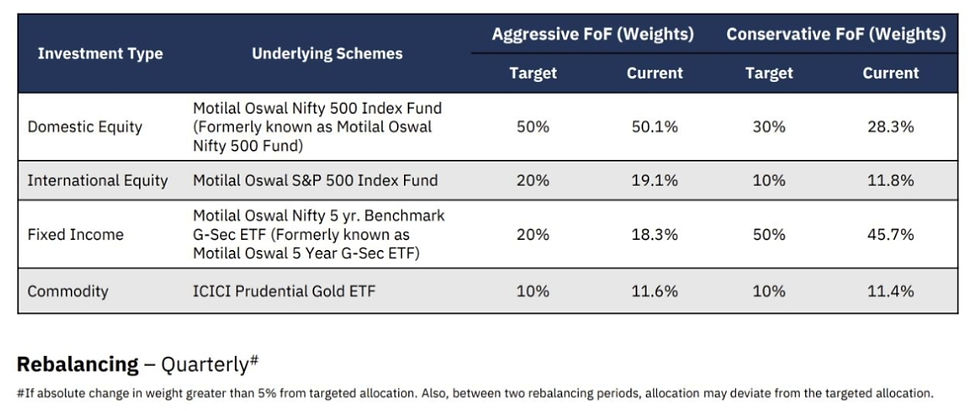
This FoF uses traditional index funds for the equity allocation. This mitigates the risk and impact of price-NAV deviations. It also has set target allocations for each asset class. This makes it a slightly better option than the Zerodha Multi Asset Passive FoF. This FoF again mainly uses proprietary (in-house) constituents. Rebalancing too is effected only when there is a significant deviation from the target allocation. But the the AUM of the fund is still quite low (around Rs 100 crore). This means that the fund may not be a good option for our portfolios.
Key Takeaways
There is nothing wrong with the broad idea of multi asset passive FoFs. The issue lies with the way they are advertised, understood and intended to be used. Multi asset passive FoFs are widely advertised as a low cost vehicle to invest in multiple asset classes. Investors understand them to be a one fund portfolio. Most investors therefore intend to use them as a substitute for asset allocation and portfolio rebalancing.
As seen today, most multi asset passive FoFs cannot justify the costs they carry. So it may not be right to call them low cost funds. Asset allocation and portfolio rebalancing are fundamental principles of personal finance. No investment product can serve as a perfect substitute for the principles of personal finance. This means that multi asset passive FoFs cannot serve as a substitute for asset allocation and portfolio rebalancing. Most people who want to buy such funds today would already have other funds in their portfolios. So adding them to the portfolio would only increase clutter. Also most of the current interest in multi asset passive FoFs has to do with the recent run up in gold prices. I am fairly certain that the interest would die down as soon as gold cools down.
It is not my intention to say that multi asset passive FoFs are fundamentally flawed or of no use. I only wish to say that there is no need to rush to buy such funds. We can give it time to see how offerings of such funds evolve. Until then we would be better off investing in standalone equity and debt funds.


Comments