Are Our Portfolios Truly Diversified?

Some questions in portfolio management are easier to answer than others. It is simple enough for anyone to calculate how much money we have made or lost on their portfolios. Calculating the portfolio's annualised return would also not be a challenge. But ask someone how diversified their portfolio is, and they would struggle for an intelligent answer. Most investors equate diversification to the number of asset classes in their portfolios. Greater the number of asset classes, the more diversified a portfolio is believed to be. But that is not always the case. Also, most people add asset classes to their portfolios for all the wrong reasons. Therefore today I am going to expose some harsh truths about the way most investors diversify their portfolios. I will then show what genuine portfolio diversification means and needs.
The Way Most People Do It
Most of us add asset classes to our portfolios because they have performed better than those we currently hold in our portfolios. For instance, close to a year back there was a mad rush to invest in gold. The desire to invest in gold was justified under the pretext of diversification. But all we actually wanted was a piece of the action in gold at that time. At present, the same kind of craze can be seen for international equity.
Indian equity has been on a low ebb for the past couple of years. And more so due to the prevailing geopolitical tensions in the Middle East. This is causing international equity to be seen as a better alternative to domestic equity. All investors are doing in both these cases is to go after returns. Diversification is therefore simply used as a front for chasing performance.

How It Should Be Done
The essence of portfolio diversification lies in risk management and reduction. Effective diversification therefore mandates holding a set of negatively correlated assets. This means an effectively diversified should and will have one or more asset classes that underperform. The presence of such asset classes is what gives rise to diversification. And it is what creates scope for portfolio rebalancing.
Rebalancing essentially involves taking money out of an outperforming asset class and putting it into an underperforming one. Doing this is what reduces portfolio risk. Aspiring to hold winning asset classes across the portfolio clearly indicates that performance is being chased blindly. It leaves no scope for rebalancing or risk reduction. A portfolio containing a set of asset classes that are all doing well can never be a diversified one.

What Effective Diversification Demands
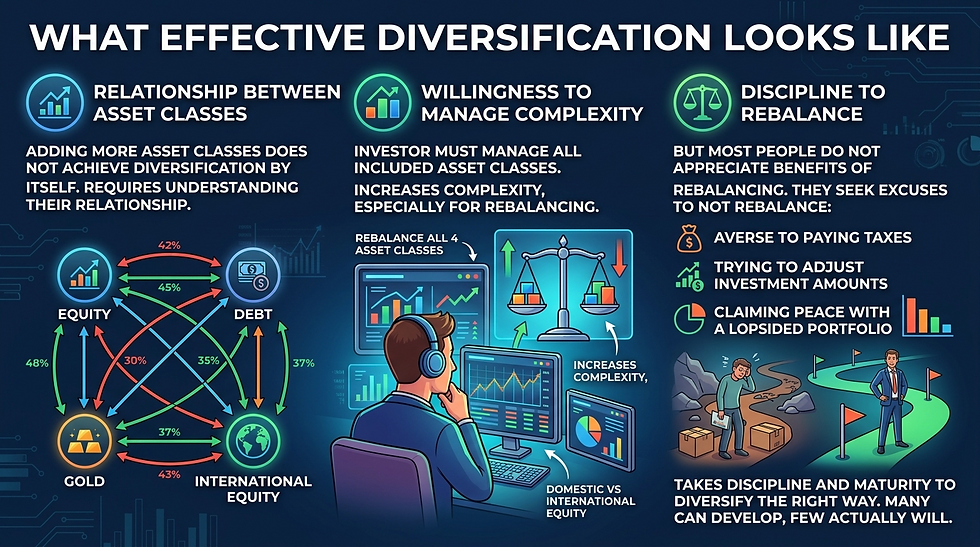
Adding more asset classes to a portfolio does not achieve diversification in and of itself. Achieving diversification requires us to first understand the relationship between various asset classes. Also if we decide to add an asset class to our portfolios, we must be willing to put it in the effort to manage it. Let us say for instance that a portfolio contains equity, debt, gold and international equity. The investor must now be willing to manage all four asset classes in the portfolio. This increases complexity especially with regard to rebalancing the portfolio.
In other words they must now be willing to rebalance between all 4 asset classes whenever required. Additionally, they must be willing to rebalance between domestic and international equity in the equity component of the portfolio. But most people do not appreciate the benefits of rebalancing in this first place. They would look for every reason and excuse possible to not rebalance the portfolio.
These include being averse to paying taxes, trying to rebalance by adjusting investment amounts and claiming to be at peace with a lopsided portfolio since they have a 'high' risk appetite. The few who do appreciate the benefits of rebalancing rarely translate intention into action. It therefore takes a lot of discipline and maturity to diversify a portfolio the right way. Everyone of us can definitely develop both of these qualities. But the harsh truth is that very few of us actually will.


Comments