A Mature Way To View Alpha, Returns And Taxes

Most investors typically aim to generate alpha on their portfolios. They usually strive to save every possible rupee in taxes. And they tend to focus most of their attention on the rate of returns their portfolios generate. But investors who are genuinely mature typically tend to view these aspects differently. This is what is likely to help them stand out against most other investors around them. I will therefore throw light on these views in today's post.
The Mature View On Alpha
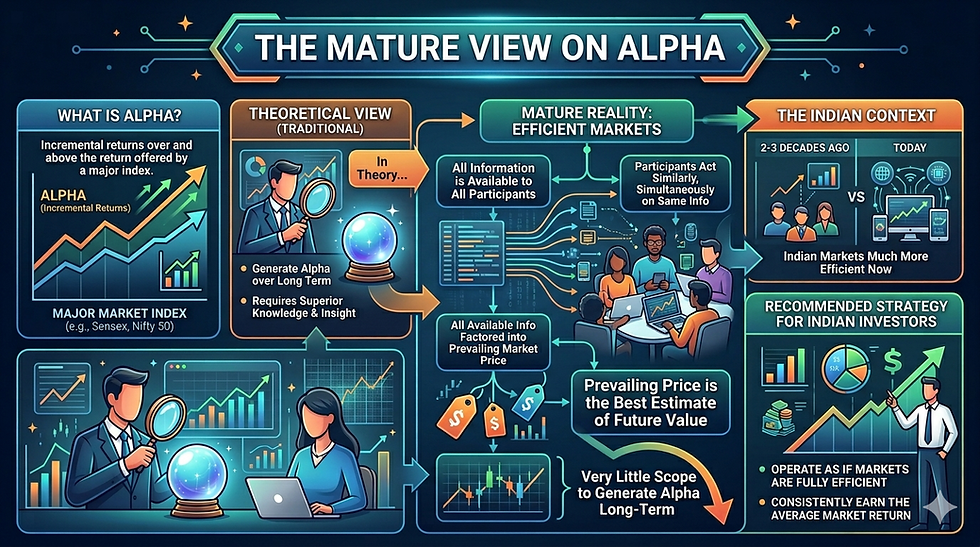
Alpha typically refers to incremental returns over and above the return offered by a major market index such as Sensex or Nifty 50. Theoretical finance suggests that it is possible to generate alpha from equity over the long term. In theory, generating alpha would require investors to have superior knowledge and insight about their equity investments relative to other investors. But mature investors realise that equity markets across most regions in the world today are virtually completely efficient.
This implies that whatever information is available about a particular investment is available to all participants in the market. Therefore all participants are likely to act on the same information, at a similar point of time in a similar way. Therefore all available information about a stock is likely to be factored into its prevailing market price. This implies that the prevailing market price of a stock is likely to be the best estimate of its future value. Therefore there is likely to be very little scope (if any) to generate alpha from equity over the long term.
The veracity of the notion of fully efficient markets is always fiercely debated. But it is widely accepted that most markets are efficient most of the time. Indian markets are a lot more efficient than they were 2-3 decades ago. Indian investors would therefore be better off behaving as if markets are fully efficient. And the best way for investors to operate in fully efficient markets is to consistently earn the average market return.
The Mature View On Portfolio Returns
Assume someone is traveling from City A to City B. They leave at 10:00 AM, intending to reach safely by 6:00 PM. As long as their driver can get them there safely by evening, why should they care whether they are with the fastest driver on the road? Portfolio performance must be viewed in much the same way. Our goal when travelling is to reach our destination on time. The goal when investing should be to have enough money for our requirements when we need it. The highest speed or rates of return are both irrelevant to their respective equations.

The Mature View On Taxes
Most Indian investors typically display a strong aversion towards paying taxes. But such an overly meticulous focus on saving taxes is likely to hinder their chances of creating lasting wealth. There was a day and age where becoming a billionaire was seen as an aspiration. But this is not so true anymore. Becoming a billionaire is less of an aspiration and more of a necessity today. So investors must develop the mindset of a billionaire right from the beginning. Billionaires would not hesitate to pay a fraction of their wealth in taxes every now and again. Investors must therefore learn to view taxes as small change they give the government on the way to becoming billionaires.
Of course tax optimisation deserves due importance as part of a pragmatic money management process. But obsessing over taxes is almost always unhealthy. So is delaying action just to avoid tax implications. Investors must learn to view the tax aspect of a particular investment as just that. One aspect among a variety of aspects about the product. Taxes should not be the central criterion based on which investment decisions are made.

Parting Thoughts
It would take a lot of humility and self awareness to learn to view these aspects as explained above. Most investors typically lack either or both of these qualities. This is why only a few investors evolve enough to become truly mature during their investment journey. But those who do are highly likely to reap the lasting benefits of the maturity they gain.


Comments